The barn was coming down Monday, and Darlene Pike wanted every board of it burned.
"I can't look at it anymore," she told Walt Brenner, standing in the barnyard with her arms crossed against the wind. "Every time I drive in, it's leaning a little farther. One of these days it'll fall on somebody."
Walt didn't disagree. The Pike barn sat on a rise off Hollow Creek Road, and it had been sagging since Walt was a boy. The roof was mostly holes. The north wall bowed out like a tired belly. Swallows lived in it, and raccoons, and probably a few things nobody wanted to meet.
Darlene was fifty-eight. Her parents had farmed this place for sixty years. Her father had passed in the spring, and her mother, Ada, was ninety-one and living at Maple Grove now. The care home cost more every month than Darlene made in two.
"I'm selling the land," she said. "The barn's just in the way. Can you take it down safe?"
"I can," Walt said. "Let me look at it first."
He walked inside with his flashlight while Biscuit waited at the door, too smart to go in.
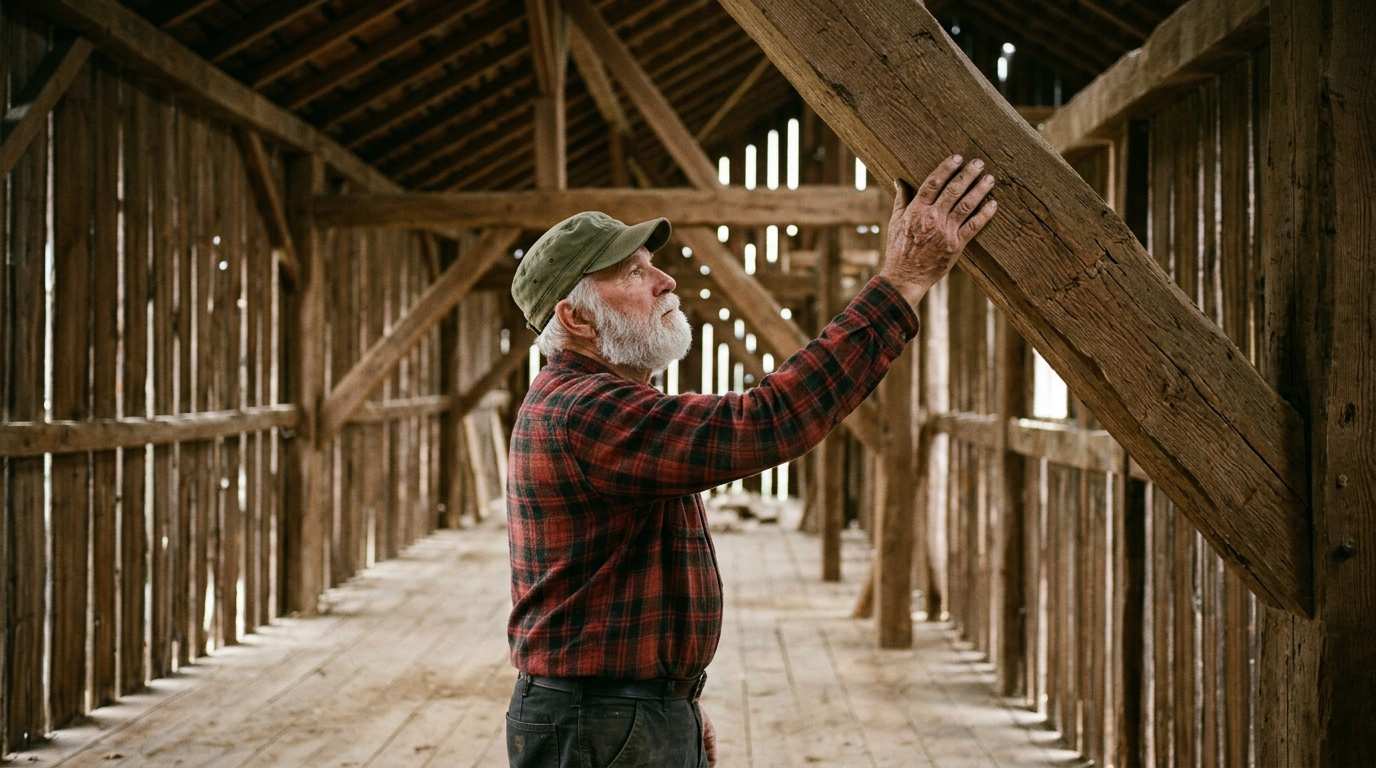
The barn was built the old way. Big hand-hewn beams, pegged together with wooden pins instead of nails. Walt ran his hand along a post. The wood was gray on the outside, rough and weathered, with little wormholes scattered through it like pepper.
He took his pocketknife out and shaved a curl off the corner of the post.
Underneath the gray, the wood was a warm, light brown, with a coarse grain that ran straight as a fence wire. He brought the shaving up to his nose.
He stood very still for a while.
Then he walked to the next post and did it again. And the next. He climbed the ladder to the hayloft, which a man his age had no business doing, and checked the rafters.
When he came out, Darlene was looking at her watch.
"Well?"
"Darlene," Walt said. "Did your dad ever tell you who built this barn?"
"My great-grandfather. Around 1900, I think. Why?"
Walt held out the shaving in his palm.
"This is American chestnut," he said. "Every beam I checked. Probably the whole frame."
Darlene looked at the curl of wood like he'd handed her a dead bug. "Is that good?"
He told her the story, standing there in the wind.
A hundred years ago, the American chestnut was one of the most common trees in the eastern woods. Billions of them. Tall, straight, and the wood didn't rot. Farmers built everything out of it. Barns, fences, cabins, furniture.
Then a blight came over from overseas in the early 1900s. Inside of forty years, nearly every chestnut tree in America was dead.
"They're basically gone," Walt said. "You can't buy new chestnut lumber. The only chestnut left is in old buildings like this one. People pay a lot of money for it. Furniture makers. Fancy houses. I've seen it go for fifteen, twenty dollars a board foot."
Darlene didn't know what a board foot was. But she could tell from his face it mattered.
"How much is a lot of money?"
Walt looked up at the barn. He was doing figures in his head, the way he had for fifty years on job sites.
"If I'm right about the size of these beams," he said, "and if most of it's sound... somewhere north of sixty thousand dollars."
Darlene laughed. It was not a happy laugh.
"That's funny," she said. "Because a man came by on Friday and offered me five thousand for it."
Walt's eyebrows went up.
As if he'd heard his name, a white pickup came up the lane twenty minutes later. On the door it said LYLE RECLAIMED TIMBER, PITTSBURGH PA.
Curtis Lyle was forty-something, friendly, with a good jacket and a clipboard. He shook Walt's hand and looked him over in a way Walt didn't love.
"Ms. Pike, I'll be honest with you," Curtis said. "Old barn wood isn't worth what it used to be. The market's flooded. But I like to help folks out. Five thousand cash, and I take the whole thing down and haul it away for you. No burning permit. No cleanup. You don't lift a finger."
He pulled out a cashier's check already made out to Darlene Pike and set it on the hood of his truck with a pen on top.
"The offer's good till five o'clock today. After that I've got another barn in West Virginia to look at."
"Walt here says it's American chestnut," Darlene said. "He says it's worth sixty thousand."
Curtis smiled at Walt like he was a nice old man who had wandered into the wrong meeting.
"With respect, sir, I do this for a living. Most of what folks think is chestnut is just old oak. And it's rotten anyway." He turned back to Darlene. "Ma'am, a carpenter who wants the demolition job is going to tell you whatever keeps him on the job."
Darlene looked at Walt.
For the first time, Walt saw the doubt in her eyes. She was tired. She was scared. She had a mother in a care home and a bank that called every week. And here was a man with a real check, right there on the hood of the truck.
"How do I know you're not after it yourself?" she asked Walt quietly.
Walt didn't answer. He knew there was nothing he could say that Curtis couldn't say right back.
Darlene looked at the check for a long time.
Then she picked up the pen.